HEAL has sent a letter to members of the European Parliament, ahead of their discussion on An ambitious Multiannual Financial Framework (MFF) 2028 - 2034 for a strong and resilient Europe, calling on decision makers to increase investments in climate resilience and pollution prevention for health.
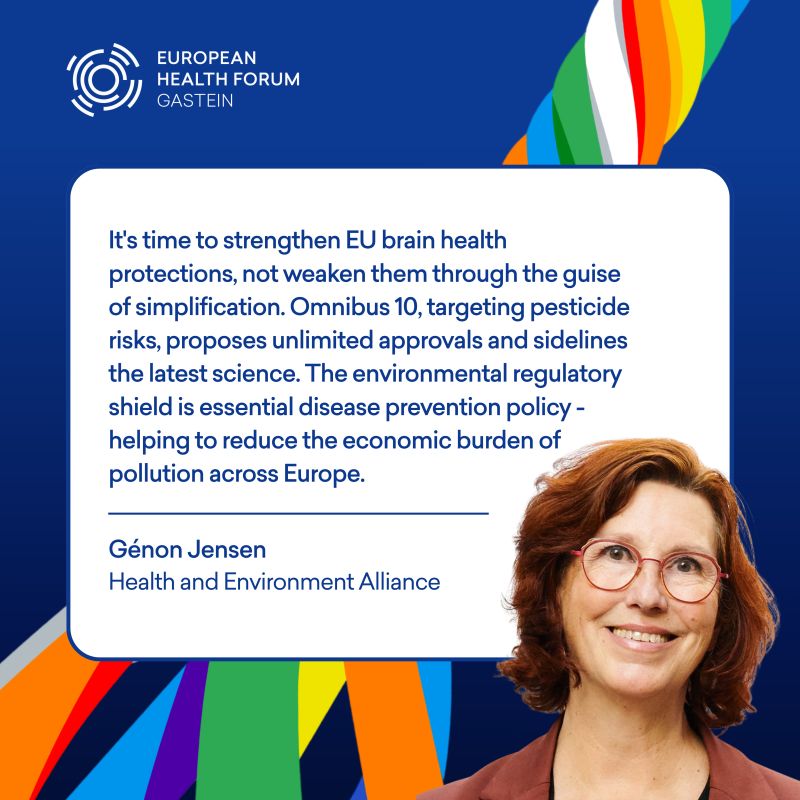
Scientists and health groups have significant concerns that the Food and Feed Safety Simplification Omnibus proposal would weaken health protection in the EU.
The science is clear: exposure to health-harming pesticides is linked to increased risk for several diseases, including childhood cancers, non-Hodgkin lymphoma, and Parkinson’s disease. In 2017 alone, the societal costs directly attributable to pesticides, including health costs, were estimated at approximately €2.3 billion.
The European Commission’s proposal would replace the regular review of pesticide approvals (every 10-15 years) with unlimited approvals by default and very limited exemptions, undermining the ability to act on new evidence. Without this systematic review system, pesticides such as chlorpyrifos, known to harm children’s brain development, may still be on the EU market today.
Weakening legislation in the name of “simplification” will lead to more illness and higher associated costs. The EU’s focus should be on the implementation, enforcement, and thorough evaluation of existing legislation to prevent disease. Not on rolling back protections. That’s why HEAL has written to Commission President Ursula von der Leyen with the request to withdraw this omnibus.
HEAL’s call is far from the only one – several warnings have been issued by scientists over the past weeks and months:
- Over 500 scientists and doctors, in a letter initiated by Professor Martina Vijver, have urged the European Parliament to pause the omnibus until an independent scientific investigation into its health and environmental impacts is carried out.
- Epidemiologists, medical doctors and public health scientists worldwide, together with the International Society of Environmental Epidemiology, have warned that the proposal would grant many pesticides unlimited approval without adequate periodic safety reassessment.
- The Endocrine Society (ES), European Society of Endocrinology (ESE), and European Society of Paediatric Endocrinology (ESPE) warned in a letter that the omnibus could significantly weaken existing health and environmental protections and could prolong human and environmental exposure to pesticides, asking to reject parts of it.
- In Italy, doctors and scientific organisations have issued an appeal, calling on Italian and European decision makers to preserve mandatory periodic pesticide reassessment.
- A group of scientists and researchers highlighted in the journal Science how implementing the Omnibus package would amplify rather than resolve shortcomings of current environmental risk assessment. They criticise the omnibus for its “poor and biased consideration of science and citizens”, the absence of a formal impact assessment and established law-making principals, and the prioritising of industry interests over environmental and public health safeguards.
- A policy brief out of Leopoldina, Germany’s National Academy of Sciences, stresses that the system of time-limited approvals is crucial for maintaining a regulatory system that can learn and take new scientific findings into account.
- Already in December 2025, over 200 members of the European scientific and medical community called on EU policy makers to reject the proposed revisions, with a letter to European Commission President von der Leyen, arguing that they would severely undermine the European Union’s ability to manage the risks associated with the use of these toxic substances, both for the environment and food safety, putting biodiversity and public health at risk.
Related Posts